
Bold Enough to Care: Declaring a New Age in Healthcare

From Daring to Know, to Daring to Care

Sapere aude.” Dare to know.

This phrase, born from the Age of Enlightenment, gave shape to one of humanity’s boldest experiments: democracy. It was a call to trust human reason, to seek truth, and to pursue knowledge for the betterment of society. It is no exaggeration to say that this call is also at the root of the American healthcare system.

We dared to know.

And because of that, medicine became more than ritual and superstition. We moved from leeches and bloodletting to science and discovery. From trial-and-error to systematic study. From a handful of healers to institutions devoted to research and training.

But daring to know has always had two faces: one of progress, and one of harm.


The Light Side of Knowledge

The Enlightenment promise was immense for medical advancement. By daring to know, physicians and scientists unlocked treatments, surgical techniques, and public health advancements that saved countless lives. We moved away from home remedies and homeopathic medicine (though some may have merit) towards evidence based scientifically replicable treatments. And, overall, we have benefited greatly from this. America became a leader in medical innovation, pioneering everything from anesthesia to organ transplantation to complex health systems designed to serve millions.

Our healthcare system, while messy, fragmented, and inequitable, is built on that foundation of relentless curiosity and advancement. That curiosity has given us breakthroughs that continue to ripple across the world.


The Dark Side of Knowledge

But there is also a shadow in this history. Daring to know often came at the expense of those deemed expendable.

In the 19th century, medical schools often relied on “body snatching” to fuel their teaching. The poor and disenfranchised, those without wealth, family advocates, or social standing, were the most vulnerable. In many schools, it even became a celebrated rite of passage for students to prove their eagerness to learn anatomy by breaking into county or city morgues to steal the bodies of unclaimed persons, alongside other inhumane practices. (Yes, really! See more)

Later, experimentation without consent became institutionalized in horrifying ways. The Tuskegee Study withheld treatment from Black men with syphilis in the name of research. The so-called “fathers of gynecology” conducted painful experiments on enslaved Black women without anesthesia, their suffering treated as collateral for medical progress.

Robert Thom/The Collection of Michigan Medicine

These legacies are not distant. We see their imprint in today’s health disparities, especially in the elevated maternal mortality rates among Black mothers in the United States. Instances when concerned pregnant black women’s pleas are ignored or dismissed, even powerful and famous black women, like tennis GOAT Serena Williams and track star Allyson Felix. Tori Bowie, Olympic Gold Medalist, tragically died due to complications of her pregnancy in 2023, complications that endured in part because of her mistrust of the health system, according to sources close to her.

Daring to know, untethered from dignity, dehumanizes those who were most vulnerable at the presumed benefit of the greater society. But, that perverse arithmetic need not endure. No life is more valuable than another’s, and we can venture to expand knowledge without exploitation and mistreatment.


A New Dare for Our Time

So what does sapere aude mean for us today?

It cannot mean knowledge at any cost. It cannot mean discovery through exploitation. It cannot mean progress that leaves dignity behind.

Instead, we must expand the phrase: dare to know, and dare to care.

  • Dare to know how dignified our practice can be.
  • Dare to know how much we can elevate the voices of patients, families, and communities.
  • Dare to know how equity can be woven into the fabric of healthcare delivery.
  • Dare to know how joy and trust can coexist with science and discovery.
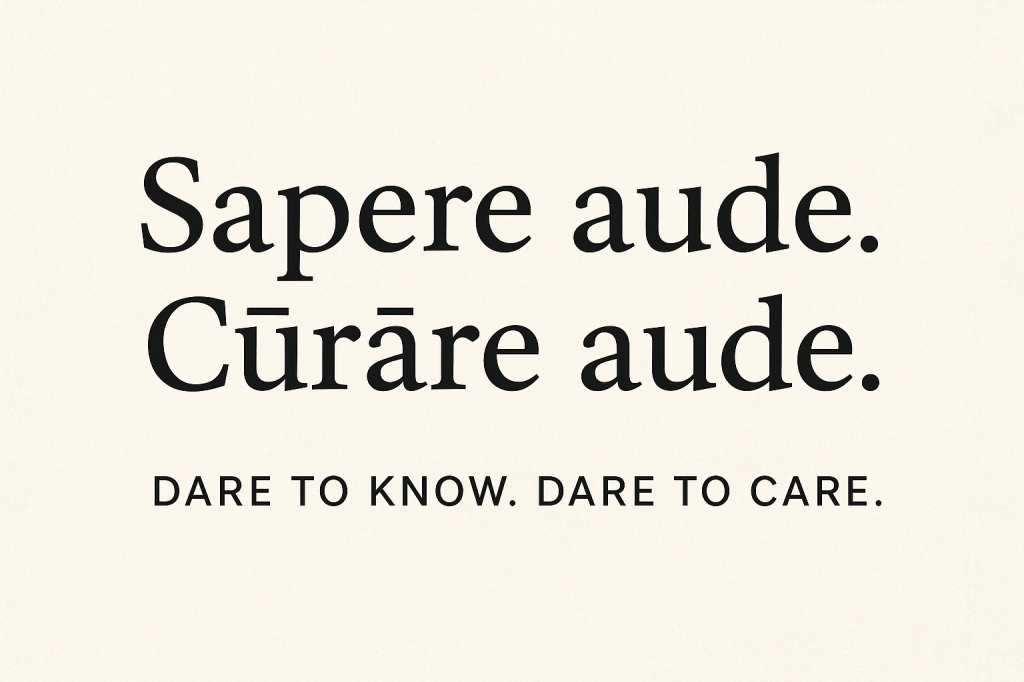
Daring Care, G.A. Silvera (2025)

We already know how to push the limits of medicine. The harder, braver work is daring to know how much better, how more compassionate, and how more just our care can become.


The Age of Enlightenment taught us to pursue truth. The American experiment taught us to test whether self-governance could endure. Our healthcare history teaches us that knowledge without dignity will always fall short.

Now, the next frontier is not just science. It is human connection. It is time to dare not only to know, but to care.

The next age could leave behind a legacy of innovation, trust, compassion, and joy. Whether history calls it the age of co-production, the age of compassion, or the age of caring doesn’t matter. What matters is that patient advocates declare a new age, again and again, at every indignity, every injustice, and every inequity we see in our systems. We must inject them with empathy, infuse them with compassion, and embolden them with joy so that no patient is ever left to suffer in a system too bold to care.

We must be bold enough to care.

Curare aude, G.A. Silvera, 2025

Sax Solos, Social Isolation, and the Science of Staying Alive

When I look at life expectancies (because I’m a nerd who does this from time to time), I like to think of them as a big family picture. I mean just look at us and how well we’re doing! Early American life was filled with disease, disconnection, and a lot, and I mean a lot of children dying before reaching the age of 2. This helps to explain how I’ve somehow outlived the average colonial American, having just reached 40 years. (You know, they’re saying 40 is the new 30, but I just started saying things like, “You know, they’re saying …”, so it’s probably not.)

Based on Data Provided by GapMinder

Though we are in the midst of a measles outbreak, I am a bit surprised we still doubt the utility of vaccines (look at that Spanish Flu dip!). It’s no surprise, though, that the lowest recorded life expectancy in U.S. history was during the Civil War. We were our own enemy. A brutal, drawn-out conflict, widespread disease, and the absence of modern medicine made survival a tall order. But today, despite medical advances, we’re facing another life expectancy crisis—one driven not by war, but by isolation.

Which brings me to a meme I recently saw that suggested a correlation between saxophone solos and birth rates. As sax solos have declined, so has human connection. Absurd? Maybe. But it highlights something real—the power of music, social interaction, and shared spaces in shaping our well-being.

The Life and Death Consequences of Social Isolation

We’ve long known that where you live affects how long you live. A recent study in Public Health Reports validated the Social Vulnerability Index (SVI) at the ZIP code level, showing that social determinants—things like economic stability, housing, and access to community resources—directly impact health outcomes.¹ But beyond physical location, social connection itself plays a critical role.

A landmark meta-analysis found that lacking social connections increases the risk of premature death by 50%, a mortality impact comparable to smoking 15 cigarettes a day.² Meanwhile, social isolation is linked to increased risks of heart disease, stroke, dementia, and mental health disorders.³ I love the suggestion by my friend and colleague, Dr. Katherine Meese, author of The Human Margin, when she jokes, that if you’re feeling lonely it might actually be better for you to grab a friend and smoke 14 cigarettes together than it is to stay isolated.

We found profound negative impacts of social isolation during the Covid-19 pandemic in our study on hospital visitation policies and their influence on patient experience and patient safety outcomes.4 It turns out the isolation was not only bad for patients, but also for our care delivery. Visitors make us better care takers, particularly in hospital settings. This reinforces the notion that human connection is essential for both emotional well-being and physical healing. In light of these findings, healthcare institutions must reevaluate visitation policies to prioritize patient-centered care that recognizes the importance of social support in the healing process.

In short: We’re social creatures, and when we lose connection, we lose years off our lives.

From Third Spaces to Algorithmic Echo Chambers

Historically, we built connection through third spaces—those community gathering places outside of home and work, like coffee shops, bars, churches, and yes, even jazz clubs with legendary sax solos. But these spaces have dwindled. The pandemic accelerated their decline, and the rise of digital interactions has, paradoxically, left us more alone than ever. Social media, once promising connection, has instead created algorithmic echo chambers that reinforce division rather than community.

Instead of moving together to the rhythms of live music, conversation, or shared experience, we’re now more likely to be swayed by the rhythm of our social media feeds.

So, What’s the Fix?

I’m not saying the answer is to listen to Careless Whisper on repeat (but if you do, at least invite some friends over). What I am saying is that we must intentionally rebuild social connection—not just for personal well-being, but as a public health priority.

  • Invest in Third Spaces: We need to rethink how we design communities, ensuring that gathering places remain accessible, inclusive, and vibrant.
  • Encourage In-Person Connection: Whether it’s community events, music, or simply making time for coffee with a friend, small moments of real-world interaction matter.
  • Acknowledge Social Isolation as a Health Risk: Public health efforts should address isolation with the same urgency as smoking, obesity, and chronic disease.

Life expectancy isn’t just about medicine—it’s about music, conversation, and shared human experience. If we want to reverse the trend, we have to do more than just treat illness. We have to bring people together.

Oh, and for what it’s worth—I made a Spotify playlist. (More Sax) Think of it as a small social lubricant on our collective behalf. (Okay, I’m done with the saxual innuendos.)


References:

  1. Social Vulnerability Index at the ZIP Code Level: Validation and Implications for Public Health. (2024). Public Health Reports. Link
  2. 2. Holt-Lunstad, J., Smith, T. B., & Layton, J. B. (2010). Social relationships and mortality risk: A meta-analytic review. PLOS Medicine, 7(7), e1000316. Link
  3. National Academies of Sciences, Engineering, and Medicine. (2020). Social Isolation and Loneliness in Older Adults: Opportunities for the Health Care System. Washington, DC: The National Academies Press. Link
  4. Silvera GA, Wolf JA, Stanowski A, Studer Q. The influence of COVID-19 visitation restrictions on patient experience and safety outcomes: A critical role for subjective advocates. Patient Experience Journal. 2021; 8(1):30-39. doi: 10.35680/2372-0247.1596. Link