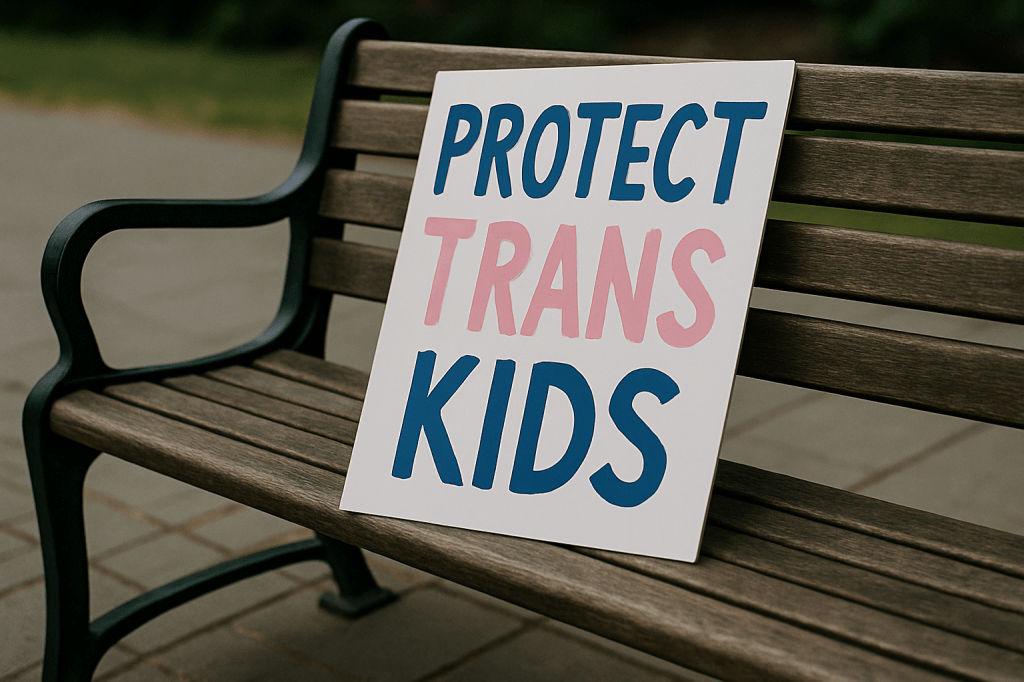
Bold Enough to Care: Declaring a New Age in Healthcare

From Daring to Know, to Daring to Care

Sapere aude.” Dare to know.

This phrase, born from the Age of Enlightenment, gave shape to one of humanity’s boldest experiments: democracy. It was a call to trust human reason, to seek truth, and to pursue knowledge for the betterment of society. It is no exaggeration to say that this call is also at the root of the American healthcare system.

We dared to know.

And because of that, medicine became more than ritual and superstition. We moved from leeches and bloodletting to science and discovery. From trial-and-error to systematic study. From a handful of healers to institutions devoted to research and training.

But daring to know has always had two faces: one of progress, and one of harm.


The Light Side of Knowledge

The Enlightenment promise was immense for medical advancement. By daring to know, physicians and scientists unlocked treatments, surgical techniques, and public health advancements that saved countless lives. We moved away from home remedies and homeopathic medicine (though some may have merit) towards evidence based scientifically replicable treatments. And, overall, we have benefited greatly from this. America became a leader in medical innovation, pioneering everything from anesthesia to organ transplantation to complex health systems designed to serve millions.

Our healthcare system, while messy, fragmented, and inequitable, is built on that foundation of relentless curiosity and advancement. That curiosity has given us breakthroughs that continue to ripple across the world.


The Dark Side of Knowledge

But there is also a shadow in this history. Daring to know often came at the expense of those deemed expendable.

In the 19th century, medical schools often relied on “body snatching” to fuel their teaching. The poor and disenfranchised, those without wealth, family advocates, or social standing, were the most vulnerable. In many schools, it even became a celebrated rite of passage for students to prove their eagerness to learn anatomy by breaking into county or city morgues to steal the bodies of unclaimed persons, alongside other inhumane practices. (Yes, really! See more)

Later, experimentation without consent became institutionalized in horrifying ways. The Tuskegee Study withheld treatment from Black men with syphilis in the name of research. The so-called “fathers of gynecology” conducted painful experiments on enslaved Black women without anesthesia, their suffering treated as collateral for medical progress.

Robert Thom/The Collection of Michigan Medicine

These legacies are not distant. We see their imprint in today’s health disparities, especially in the elevated maternal mortality rates among Black mothers in the United States. Instances when concerned pregnant black women’s pleas are ignored or dismissed, even powerful and famous black women, like tennis GOAT Serena Williams and track star Allyson Felix. Tori Bowie, Olympic Gold Medalist, tragically died due to complications of her pregnancy in 2023, complications that endured in part because of her mistrust of the health system, according to sources close to her.

Daring to know, untethered from dignity, dehumanizes those who were most vulnerable at the presumed benefit of the greater society. But, that perverse arithmetic need not endure. No life is more valuable than another’s, and we can venture to expand knowledge without exploitation and mistreatment.


A New Dare for Our Time

So what does sapere aude mean for us today?

It cannot mean knowledge at any cost. It cannot mean discovery through exploitation. It cannot mean progress that leaves dignity behind.

Instead, we must expand the phrase: dare to know, and dare to care.

  • Dare to know how dignified our practice can be.
  • Dare to know how much we can elevate the voices of patients, families, and communities.
  • Dare to know how equity can be woven into the fabric of healthcare delivery.
  • Dare to know how joy and trust can coexist with science and discovery.
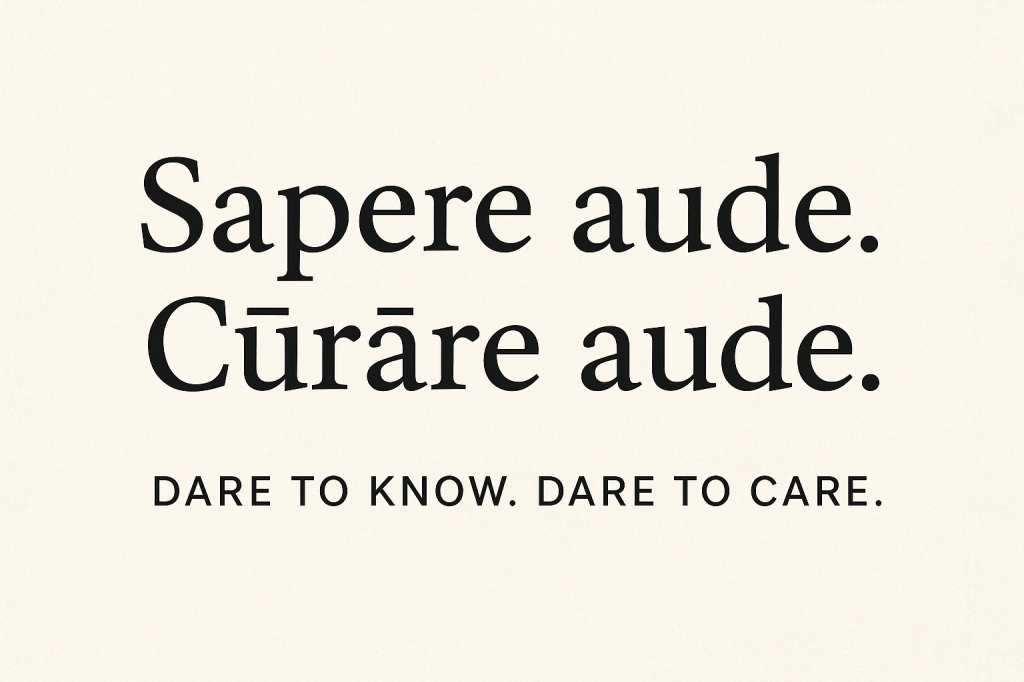
Daring Care, G.A. Silvera (2025)

We already know how to push the limits of medicine. The harder, braver work is daring to know how much better, how more compassionate, and how more just our care can become.


The Age of Enlightenment taught us to pursue truth. The American experiment taught us to test whether self-governance could endure. Our healthcare history teaches us that knowledge without dignity will always fall short.

Now, the next frontier is not just science. It is human connection. It is time to dare not only to know, but to care.

The next age could leave behind a legacy of innovation, trust, compassion, and joy. Whether history calls it the age of co-production, the age of compassion, or the age of caring doesn’t matter. What matters is that patient advocates declare a new age, again and again, at every indignity, every injustice, and every inequity we see in our systems. We must inject them with empathy, infuse them with compassion, and embolden them with joy so that no patient is ever left to suffer in a system too bold to care.

We must be bold enough to care.

Curare aude, G.A. Silvera, 2025

Strategic Pauses: Unlocking Creativity and Clarity

Remember that time I shared that line, “Good, Better Best, Never let it rest, until your Good becomes your Better and your Better becomes your Best.”, yeah, I was wrong. Rest is really really good and it turns out it can be helpful in getting from good to best too.

I have returned from a purposeful pause from blogging that felt intentional, restorative, and absolutely necessary. In this time, I’ve realized something vital for leadership and patient care:

There is power in the pause.


Pause for Empathy and Preparation

In healthcare, empathy isn’t just a feeling, it’s an active skill, shaped as much by intention as by emotion. Before entering a patient room, what if we practiced an empathy pause?

An empathy pause is taking a moment to ask:

  • How might I feel receiving these words?
  • What resources or support would matter most right now?

This moment is about more than self-awareness, it’s a bridge toward understanding another’s lived experience. It is useful in patient encounters and in management as well.

Brené Brown’s research on vulnerability highlights that the foundation of empathy is born when we allow ourselves to pause, feel, and lean into uncertainty. As she puts it, vulnerability is necessary for real connection and “our most accurate measure of courage” (podcastworld.io). These empathy pauses are acts of courage, they bring clarity and deepen communication by slowing us down enough to truly hear and value another’s lived experience.


Pause Sustains Creativity and Reflection

Pausing is not a passive activity, it’s strategic. Adam Grant has noted that allowing the mind to remain with unfinished tasks keeps them active in your subconscious. Drawing on the Zeigarnik effect, he explains that this state of mental simmer can boost creativity and insight (npr.org). I especially love the line he shares from Aaron Sorkin, “You call it procrastinating. I call it thinking.”. We need time to process things organize them and that takes time and often means we have to walk away from a task, while incomplete, to figure out our next best steps.

An example of how we can set ourselves up for success with this comes from something I learned when I was in my doctoral program. I was advised to always end a writing session in the middle of “a downhill”, like writing the first sentence of the next paragraph. It became its own act of motivation as it encourages me to get my ideas organized for the next writing session. So when I sit down next time, I basically written through the next paragraph or two before I ever have to think about what to say next.

We can do this in all kinds of tasks. It’s not my wife’s favorite, but with two young children I don’t ever seem to have the time to do all of the dishes in one go. So I do them categorically. I wash the plates, then the bowls, then mugs, etc. It might be a neurosis, but it helps when I get interrupted…

Let me be honest, I want to be interrupted!

If I am interrupted between categories, I will wash one of the next category. When I see one bowl sitting in the dryer rack it is a glaring reminder to go finish the dishes. Have you ever seen a single fork on a drying rack next to a pile of dirty dishes? Try it, it will drive you to action, I promise.


The Pause in Dialogue and Music

I once heard this line about a musician and I have also heard it said about great actors and actresses. It is not how they play the notes, it is how they play the pauses. I recently watched the classic, “You make me want to be a better man.” scene from the movie As Good As it Gets. Jack Nicholas and Helen Hunt have this beautiful back and forth where the writing is absolutely superb, but that is not what makes the scene. It is how they each are acting when the other actor is speaking. They are both phenomenal in that scene at playing the pauses.

By playing the pauses we give space that allows meaning to emerge. As with great actors and musicians, who use silence like a second instrument, intentional silence in our conversations and our care can give voice to emotion and meaning. This is where humanity and connection live. How many times have you been half listening to someone until they pause mid-sentence? We are built to identify patterns they are soothing to us, so when a pattern breaks, we are programmed to investigate. So the pauses are immediately interesting to our perceptions and what happens in them can be a great opportunity for connection.

In practice, there are a few things we can do when taking an intentional pauses like taking time for deliberate reflection, like “What assumptions am I making?” or “What values might inform this decision?”.

Playing the pauses transforms downtime into development time (news.harvard.edu). The Harvard Business School found that leaders who incorporate short strategic pauses perform 34% better in decision-making and foster environments where teams are more likely to voice concerns early (higherperformancegroup.com). Purpose becomes clear, reactions become measured, and creativity emerges from the cracks between moments.


The Dark Side of Pausing

Pause is a powerful tool, until it isn’t.

There are a great many instances of this as of late, but pausing too loudly or for too long has risks as well. First of all, I’ll just say what some of you might’ve already been thinking, pausing can never be stopping. That’s not strategic pausing, that is strategic cowardice. If you want to stop doing something, you can just stop doing it, but announcing that you will be taking a moment to assess a situation that you then eventually decide against is just risk mitigation and everyone sees it plainly. The most pressing example of this is what has occurred across industries with respect to diversity, equity, inclusion, and belonging, and the response to the anti-woke movement.

Pausing to understand emerging social movements and counter movements and how your organizations will respond is wise. But when the pause is not followed by any substantive action, the silence speaks loudly. In moments of political tension or moral urgency, institutional pauses can inadvertently communicate silence as disapproval. In today’s anti-woke environment, when organizations silence their advocacy for marginalized communities, the pause becomes a void. The pause becomes a loudspeaker for many in these communities that all of the actions the organization once engaged in to support DEI were never authentic or legitimate. The absence of support feels like withdrawal. In instances like these pausing isn’t neutral, silence a statement.

As I reflect, pause wisely, but don’t slow to silence.


Pause as Shared Vulnerability

True leadership invites shared vulnerability. Brené Brown’s work, particularly in Dare to Lead, emphasizes that courage isn’t acting tough, it’s being honest about uncertainty (npr.org). A culture of pause wherein leaders surface their own unanswered questions builds psychological safety. In times of uncertainty, people are looking for leaders to say, “Look I don’t know what we are going to do in this new environment, but I know our shared values will lead us to next best steps. While we work to build a plan, if you have suggestions or concerns, please reach out to the leadership team to help us make the best next move.”. In this way, an intentional pause in times of uncertainty can become a team-builder, a psychological safety incubator, bringing trust, innovation, and creativity to a confusing situation.

Perhaps rather than Good, Better, Best being wrong perhaps it just needs another stanza.

Good, better, best,

never let it rest,

until your good becomes your better,

and your better becomes your best.

But if along the way,

you find yourself distressed,

take a pause, then carry on,

and soon you’ll be your best.


In Closing

Pauses can be power: to ground us, to prepare us, to open us. They allow us to lead and care with empathy, courage, and intentionality. But in a world that also demands action and affirmation, we must ensure our pauses are deliberate action that do not lead to absence.

Practical “Pause Prompts” for Leaders & Clinicians

Here are pauses that make difference:

  • Before critical communication: “Let me pause for a moment. What am I assuming, and how will this land?”
  • At decision junctions: “I’d like 5 minutes to reflect, my brain will keep working on this in the background.”
  • During conversations: “I want to check in, how does this land with you?”
  • After advocacy efforts: “What’s our next step? Silence here will speak louder than words.”

References & Further Reading

  • Basically anything by Brené Brown on vulnerability and leadership
  • Adam Grant on creativity, reflection & the Zeigarnik effect (npr.org)
  • Harvard Business School: strategic pauses improve decision-making by 34% (higherperformancegroup.com)
  • Community case: leader’s pause in crisis yields stronger team outcomes (higherperformancegroup.com)

Yard work and Health Administration: Designing for Delight, Not Just Duty

Let’s be honest: yard work is not fun.

It’s tedious. It’s repetitive. You sweat. You pull weeds only to see more next week. You mow, trim, rake, and then do it all over again. The labor isn’t the reward. We do it because we’re after something else: a yard we can enjoy. A space to host friends, watch the kids play, sip coffee in the morning. A space that feels good.

We don’t want to experience our yards as a chore.
We want to experience them as joy.

Now think about the best outdoor places you’ve been—a neighborhood park, a botanical garden, a golf course, maybe a favorite trail. These spaces didn’t just happen. They were shaped with intention. Someone thought about what you would see, where you might pause, and how you would feel while moving through them. Often, they were thinking about your experience long before you even arrived.

When I was an undergrad, I stumbled into a study abroad program led by the landscape architecture department. I’ll admit it—I chose it because it was two weeks long instead of one. But what I got was a deep, surprising education in the emotional power of space. We used the city of Paris as our classroom and traced the legacy of André Le Nôtre, the visionary behind the gardens of Versailles.

Our instructor talked about more than just beauty—they talked about emotional design. About how great spaces don’t just impress you, they invite you in. You don’t feel directed, you feel drawn. You don’t notice the symmetry or the structure. You just feel calm, or awe, or joy.

Great design disappears.
And in its absence, experience is born.

This idea stretches far beyond gardens.

Take healthcare, for example.

Too often, healthcare administration feels like yard work with its endless checklists, processes, fixes. We dig into spreadsheets. We prune workflows. We patch inefficiencies and pull bureaucratic weeds. Important, yes. But inspiring? Rarely.

But what if we approached healthcare like Le Nôtre approached Versailles?
What if we designed for delight, not just duty?

Think of a hospital or health system as a vast garden.

The CEO becomes the master landscape architect crafting a master vision. Senior administrators are the gardeners, executing on the vision by nurturing the system, correcting what’s overgrown. This analogy goes deep … Your data teams? The irrigation system, quiet, essential, working beneath the surface to ensure a thriving ecosystem of interactions from supply chain to human resources to care delivery. Frontline staff?well they are the flowers, of course, they are the big show and who and what patients will most remember and return to. And the patients? They are the guests in our garden, the ones we design for.

When I was in Paris, we learned about a public rose garden where city sanitation workers hand-pruned each bush, and they did this daily! Not just to clear trash, but to pluck fading blooms before anyone could see them. The designer had envisioned only perfect roses in their original design, and the visitors expect only roses in bloom, and so, to honor their promise to uphold the design and to honor the guests, these workers worked diligently at their tasks and held that promise. That labor wasn’t about aesthetics, it was not about looking like you care, it was about delivering on a promise to provide the best experience. The joy of the visitor relied on the discipline of the sanitation worker.

Likewise, when you smooth out a clunky intake form, fix an IT glitch, or redesign a scheduling process, it might feel like yard work. But it can be the thing that helps a frightened patient feel calmer, or gives a clinician five minutes back in their day, or helps a family find clarity when they need it most.

You’re not just fixing things.
You’re creating Versailles.

Yes, it’s repetitive. Yes, it’s work. But it’s not meaningless. Because when healthcare systems work well, when they feel seamless, inviting, humane—it’s because someone behind the scenes was tending the garden.

So don’t focus on the weeds. Focus on the experience you’re cultivating for patients, for providers, for families.

The best gardens and the best healthcare systems share something in common:
They require constant, quiet care.

And when they’re working just right, you don’t notice the effort.

You just feel better.

From Theme Parks to Seamless Care: What Healthcare Can Learn from Disney

Recently, I had the opportunity to tour a local hospital that has the distinction of being both academic medical center and safety-net hospital. We spent a lot of time examining patient flow and emergency department overcrowding—and I couldn’t help but think about Disney World.

Wheelchair Person” by Direct Media/ CC0 1.0

Disney is a master of movement—orchestrating guest flow through its parks so that everyone gets to the right ride, restaurant, or show with minimal frustration. For many years, patient experience gurus lauded this model for its highlighting the experience while waiting. The waiting room is an experience, the exam room is another, and then the interactions with the care providers, all of them contributing to the overall experience especially in doctor’s offices. But, lets get real— no one enjoys the TVs playing HGTV non-stop for hours on end. I could go on forever on my distaste for doctor’s office waiting rooms, but it seems hospitals are doing much of the same.

On my visit, I learned of several patient flow innovations:

  • A patient flow coordination room, what they called an “air traffic control room” that tracks every patient—incoming, outgoing, and waiting.
  • Overflow areas designed to help absorb surges in emergency visits, with plans for even more capacity.
  • A discharge lounge which holds patients who are medically ready to leave but waiting for transportation.
"Air traffic control" Patient Command Central
“Air traffic control” Patient Command Central photo by G. Silvera

There’s an entire logistics operation designed to move patients efficiently. The ethos, if I understand it correctly, is sound and perhaps even noble. Patients who need care should be able to access care and if there is a patient that no longer needs care or can be better taken care of at another level, we need to move them along to open up space for the next patient. But here’s the thing: everywhere is full at every level.

We have pioneered systems to improve intake, and still, patient overflow is an issue. Every innovation that I have seen to address patient flow ends up butting up against the same reality, at some point, there is nowhere else to send the patient. We have organized too many of our systems in this country for the next patient, and, far too often, we have done so at the expense of the patient in front of us.

And I’ll say it again, because it is worth repeating, the queue is not the patient.

Disney Wants to Keep People Moving. Healthcare Shouldn’t.

Crowds line the way to Cinderella Castle at the Magic Kingdom.Credit...Joe Burbank/Orlando Sentinel, via Associated Press
Crowds line the way to Cinderella Castle at the Magic Kingdom. Credit…Joe Burbank/Orlando Sentinel, via Associated Press

Disney’s goal is to keep you flowing through different experiences—moving from ride to ride, maximizing time in the park. Hospitals should have the opposite goal:

  • 🚫 Minimize unnecessary patient movement
  • 🚫 Keep care as close to the patient as possible
  • 🚫 Ensure every transfer serves a real purpose

What Healthcare Can Learn from Disney+

Think about how Disney changed retail strategies.

  • Disney Stores once brought the magic to malls
  • Now, Disney+ brings the magic directly to homes

Healthcare is undergoing a similar transformation:
✔ Telehealth eliminates the need for travel
✔ Home-based care brings services to patients
✔ Hospital-at-home models provide inpatient-level care outside traditional walls

Photo by Edward Jenner on Pexels.com

Yet, inside hospitals, we still shuffle patients around— transferring them between rooms, waiting areas, departments, and even hospitals. To what end? What is the meaning behind the movement? Is it for patient’s needs or someone else’s?

What If We Built Minimally Disruptive Hospitals?

There’s a concept called Minimally Disruptive Medicine that focuses on reducing the disruption of medical visits—especially for elderly patients who rely on caregivers for transportation and support.

What if we applied this thinking inside hospitals?

  • Fewer unnecessary transfers
  • More bedside diagnostics and treatment
  • Care moving to patients, instead of patients moving to care

I am not sure what it would look like exactly, but I have an image of care providers moving through a patient room rather than patients moving through the hospital. For the clinically inclined, what if instead of being the blood that pumps through the hospital, patients were the heart. I encourage us all to think more critically about how disruptively care is currently modeled. Because in the end, patients are not guests in our hospitals.


We are guests in their lives.

Caregiver Nurse” by Direct Media/ CC0 1.0

What Do You Think?

Are we designing hospitals for operational efficiency instead of patient dignity? How can we make hospital care less disruptive and more patient-centered?

Drop your thoughts in the comments—I’d love to hear your perspective.

#PatientExperience #HealthcareLeadership #MinimallyInvasiveCare #HospitalFlow #PatientFirst #Disney #HealthcareInnovation