Why healthcare transformation depends on both data and depth
We measure everything in healthcare: wait times, readmissions, survey scores … but sometimes, in the rush to quantify everything, analyze it, and report on the numbers, we lose what’s most essential.
In my latest commentary for the Patient Experience Journal, I reflect on something I was able to share with the Patient Experience Symposium last month. I explore how we can bridge the gap between what we measure and the meaning behind the numbers. Patient experience isn’t a choice between numbers and narratives, it’s the ability to see both clearly. This is how we listen and learn from patients to drive transformation of health systems.
Metrics give us structure, accountability, and shared language.
Narrative gives us empathy, insight, and direction.
When we combine the two, we move beyond reporting to understanding. We begin to see patterns that tell us not just how care is delivered, but how it’s felt, and, ultimately, how we can evolve.
In the commentary, I also introduce a metaphor that I hope will be a helpful reminder to look beyond the data to the quiet, graceful shape forming above it all.
Lately, things have been going right. Awards. Wins. New role. Family milestones. All the stuff that signals progress.
And I am grateful, deeply. But I’m not satisfied.
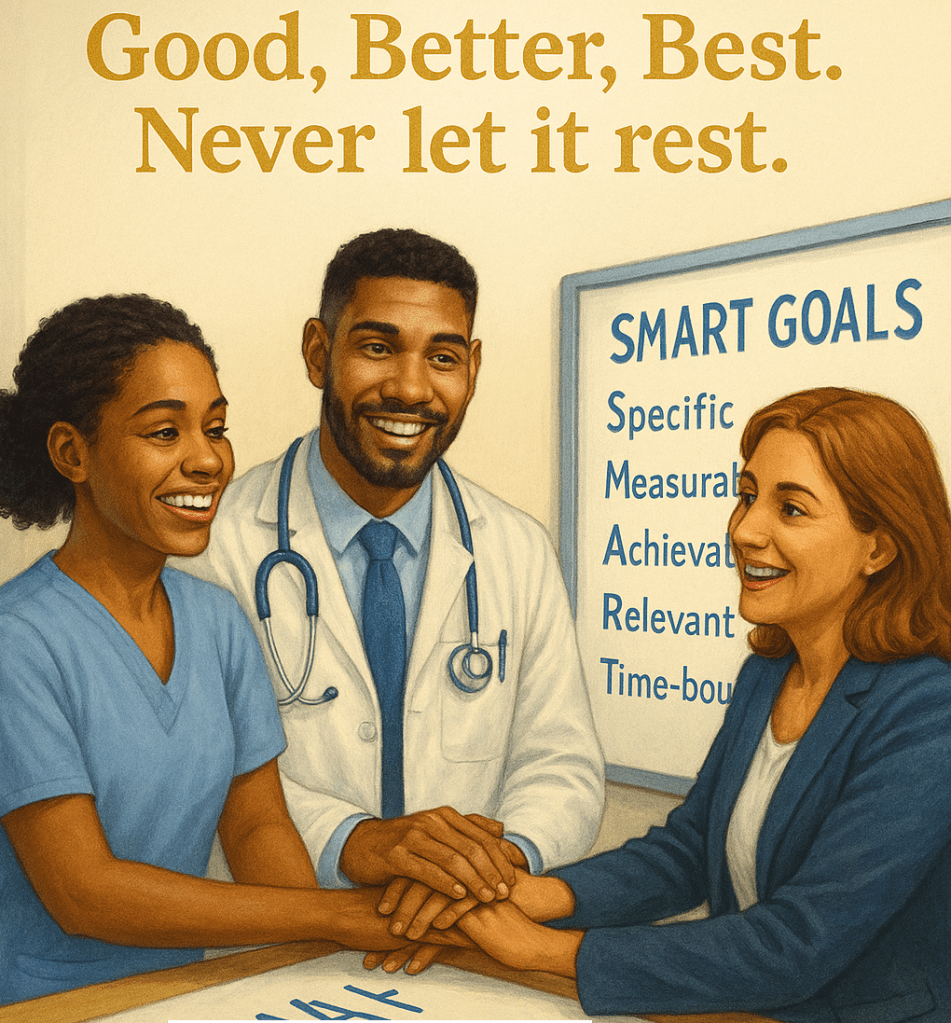
There’s this motto I grew up with, something my Caribbean parents (and just about every schoolteacher I knew) used to say: “Good, better, best. Never let it rest until your good becomes your better and your better becomes your best.”
It was drilled into us as kids, but the older I get, the more I understand it’s not about perfection. It’s about pressure, positive pressure. The kind of positive momentum that keeps you moving even when the world says you’ve probably done well enough.
Better…
Lately, I’ve been thinking about what it means to reach for “best”. Not as a final destination, but as a standard of intention. In healthcare, especially, that’s a radical concept. “Best” is a moving target. “Best” is context-dependent. “Best” is often unattainable.
But when we say “best”, we don’t necessarily mean ideal. In every scenario, the ideal is that our patients would not need us, that they would live healthful lives, in environments that prioritize their wellness, that the powers that be would center every decision on patient’s individual wellbeing. Ideal is not attainable, but our best is.
When we tell ourselves that we will deliver the care that we’d give our mothers.
That’s the real metric. That is a standard we can hold ourselves to.
With Mother’s Day on the horizon, I find myself asking: If your mother were the patient, would you be okay with “pretty good”? With “most days, we get it right”? How could you justify anything less than your best for her?
You wouldn’t. You couldn’t. And that’s the whole point.
(The image is not my mother, she would want you to know that. She’s much more beautiful than even AI could imagine.)
The Science of Striving: Goal Setting in Healthcare
Research underscores the importance of goal setting in driving performance and improvement. In healthcare, setting specific, challenging goals has been shown to effectively motivate attainment, especially when formulated within a SMART framework (Specific, Measurable, Achievable, Relevant, Time-bound) . Moreover, engaging patients in goal-setting processes enhances their confidence, motivation, and satisfaction with care, highlighting the collaborative nature of striving for “best” in clinical settings .
Tim Duncan: A Case Study in Consistent Excellence
Tim Duncan, the NBA Hall of Famer known as “The Big Fundamental,” exemplifies the “good, better, best” philosophy. Raised in the U.S. Virgin Islands, Duncan was taught this mantra by his late mother, which he carried throughout his basketball career . His unwavering commitment to excellence, humility, and teamwork led to five NBA championships and a legacy of consistent performance. Duncan’s approach wasn’t about flashy plays but about doing the right thing, the right way, every time. A lesson that resonates deeply in the pursuit of excellence in healthcare.
Best…
Patient Experience Week just passed. Nurses Week is here. These are moments when we pause to celebrate the incredible things healthcare professionals make possible when they operate at full capacity, when they lead with heart, skill, and grit. We’ve seen what’s possible when people show up and give it everything they’ve got.
But the celebrations also shine a light on what we’re still not doing. On the systems that are still too slow. On the experiences that are still inconsistent. On the gaps we’ve normalized.
And if we’re serious about change, we have to admit that we haven’t seen us at our best yet.
You think you know what you’re capable of, but our best is still out ahead of us, waiting to be reached. Potential is a dare. Best is a challenge.
The wins are worth celebrating. It is important to celebrate each other in the pursuit of excellence. But we are not celebrating an end, we have not accomplished all that we will accomplish. We are celebrating our ongoing commitment to the noble pursuit of excellence in health care.
Because we’re serious about equity, about empathy, about excellence, we can’t stop at “good” enough. We can’t even stop at “better.” We have to keep going. For our patients. For our teams. And yes, for our mothers.
In both healthcare and life, the pursuit of “best” is a continuous journey. It’s about setting goals that challenge us, collaborating with others to achieve them, and never settling for “good enough.” As we honor the dedication of healthcare professionals during Nurses Week and reflect on the care we provide, let’s remember to strive for the excellence we’d expect for our own mothers. Because in the end, every patient deserves nothing less than our best.
Recently, I had the opportunity to tour a local hospital that has the distinction of being both academic medical center and safety-net hospital. We spent a lot of time examining patient flow and emergency department overcrowding—and I couldn’t help but think about Disney World.
Disney is a master of movement—orchestrating guest flow through its parks so that everyone gets to the right ride, restaurant, or show with minimal frustration. For many years, patient experience gurus lauded this model for its highlighting the experience while waiting. The waiting room is an experience, the exam room is another, and then the interactions with the care providers, all of them contributing to the overall experience especially in doctor’s offices. But, lets get real— no one enjoys the TVs playing HGTV non-stop for hours on end. I could go on forever on my distaste for doctor’s office waiting rooms, but it seems hospitals are doing much of the same.
On my visit, I learned of several patient flow innovations:
A patient flow coordination room, what they called an “air traffic control room” that tracks every patient—incoming, outgoing, and waiting.
Overflow areas designed to help absorb surges in emergency visits, with plans for even more capacity.
A discharge lounge which holds patients who are medically ready to leave but waiting for transportation.
“Air traffic control” Patient Command Central photo by G. Silvera
There’s an entire logistics operation designed to move patients efficiently. The ethos, if I understand it correctly, is sound and perhaps even noble. Patients who need care should be able to access care and if there is a patient that no longer needs care or can be better taken care of at another level, we need to move them along to open up space for the next patient. But here’s the thing: everywhere is full at every level.
We have pioneered systems to improve intake, and still, patient overflow is an issue. Every innovation that I have seen to address patient flow ends up butting up against the same reality, at some point, there is nowhere else to send the patient. We have organized too many of our systems in this country for the next patient, and, far too often, we have done so at the expense of the patient in front of us.
And I’ll say it again, because it is worth repeating, the queue is not the patient.
Disney Wants to Keep People Moving. Healthcare Shouldn’t.
Crowds line the way to Cinderella Castle at the Magic Kingdom. Credit…Joe Burbank/Orlando Sentinel, via Associated Press
Disney’s goal is to keep you flowing through different experiences—moving from ride to ride, maximizing time in the park. Hospitals should have the opposite goal:
🚫 Minimize unnecessary patient movement
🚫 Keep care as close to the patient as possible
🚫 Ensure every transfer serves a real purpose
What Healthcare Can Learn from Disney+
Think about how Disney changed retail strategies.
Disney Stores once brought the magic to malls
Now, Disney+ brings the magic directly to homes
Healthcare is undergoing a similar transformation: ✔ Telehealth eliminates the need for travel ✔ Home-based care brings services to patients ✔ Hospital-at-home models provide inpatient-level care outside traditional walls
Yet, inside hospitals, we still shuffle patients around— transferring them between rooms, waiting areas, departments, and even hospitals. To what end? What is the meaning behind the movement? Is it for patient’s needs or someone else’s?
What If We Built Minimally Disruptive Hospitals?
There’s a concept called “Minimally Disruptive Medicine” that focuses on reducing the disruption of medical visits—especially for elderly patients who rely on caregivers for transportation and support.
What if we applied this thinking inside hospitals?
Fewer unnecessary transfers
More bedside diagnostics and treatment
Care moving to patients, instead of patients moving to care
I am not sure what it would look like exactly, but I have an image of care providers moving through a patient room rather than patients moving through the hospital. For the clinically inclined, what if instead of being the blood that pumps through the hospital, patients were the heart. I encourage us all to think more critically about how disruptively care is currently modeled. Because in the end, patients are not guests in our hospitals.
Are we designing hospitals for operational efficiency instead of patient dignity? How can we make hospital care less disruptive and more patient-centered?
Drop your thoughts in the comments—I’d love to hear your perspective.









 Geoffrey Silvera, PhD MHA