
From Daring to Know, to Daring to Care
“Sapere aude.” Dare to know.
This phrase, born from the Age of Enlightenment, gave shape to one of humanity’s boldest experiments: democracy. It was a call to trust human reason, to seek truth, and to pursue knowledge for the betterment of society. It is no exaggeration to say that this call is also at the root of the American healthcare system.
We dared to know.
And because of that, medicine became more than ritual and superstition. We moved from leeches and bloodletting to science and discovery. From trial-and-error to systematic study. From a handful of healers to institutions devoted to research and training.
But daring to know has always had two faces: one of progress, and one of harm.
The Light Side of Knowledge
The Enlightenment promise was immense for medical advancement. By daring to know, physicians and scientists unlocked treatments, surgical techniques, and public health advancements that saved countless lives. We moved away from home remedies and homeopathic medicine (though some may have merit) towards evidence based scientifically replicable treatments. And, overall, we have benefited greatly from this. America became a leader in medical innovation, pioneering everything from anesthesia to organ transplantation to complex health systems designed to serve millions.
Our healthcare system, while messy, fragmented, and inequitable, is built on that foundation of relentless curiosity and advancement. That curiosity has given us breakthroughs that continue to ripple across the world.
The Dark Side of Knowledge
But there is also a shadow in this history. Daring to know often came at the expense of those deemed expendable.
In the 19th century, medical schools often relied on “body snatching” to fuel their teaching. The poor and disenfranchised, those without wealth, family advocates, or social standing, were the most vulnerable. In many schools, it even became a celebrated rite of passage for students to prove their eagerness to learn anatomy by breaking into county or city morgues to steal the bodies of unclaimed persons, alongside other inhumane practices. (Yes, really! See more)
Later, experimentation without consent became institutionalized in horrifying ways. The Tuskegee Study withheld treatment from Black men with syphilis in the name of research. The so-called “fathers of gynecology” conducted painful experiments on enslaved Black women without anesthesia, their suffering treated as collateral for medical progress.

These legacies are not distant. We see their imprint in today’s health disparities, especially in the elevated maternal mortality rates among Black mothers in the United States. Instances when concerned pregnant black women’s pleas are ignored or dismissed, even powerful and famous black women, like tennis GOAT Serena Williams and track star Allyson Felix. Tori Bowie, Olympic Gold Medalist, tragically died due to complications of her pregnancy in 2023, complications that endured in part because of her mistrust of the health system, according to sources close to her.
Daring to know, untethered from dignity, dehumanizes those who were most vulnerable at the presumed benefit of the greater society. But, that perverse arithmetic need not endure. No life is more valuable than another’s, and we can venture to expand knowledge without exploitation and mistreatment.
A New Dare for Our Time
So what does sapere aude mean for us today?
It cannot mean knowledge at any cost. It cannot mean discovery through exploitation. It cannot mean progress that leaves dignity behind.
Instead, we must expand the phrase: dare to know, and dare to care.
- Dare to know how dignified our practice can be.
- Dare to know how much we can elevate the voices of patients, families, and communities.
- Dare to know how equity can be woven into the fabric of healthcare delivery.
- Dare to know how joy and trust can coexist with science and discovery.
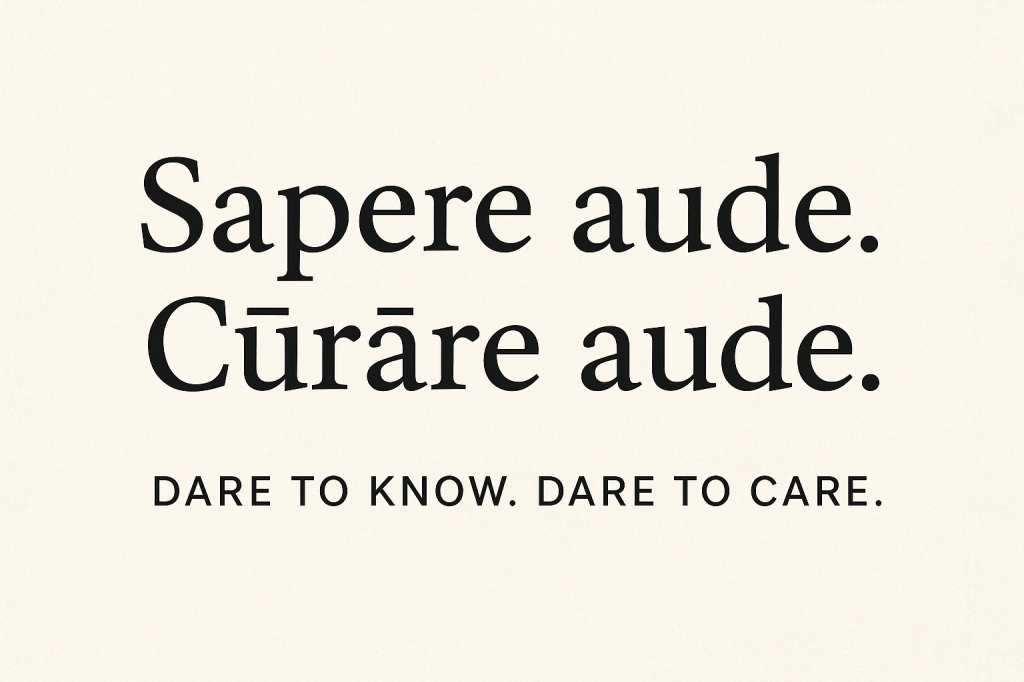
We already know how to push the limits of medicine. The harder, braver work is daring to know how much better, how more compassionate, and how more just our care can become.
The Age of Enlightenment taught us to pursue truth. The American experiment taught us to test whether self-governance could endure. Our healthcare history teaches us that knowledge without dignity will always fall short.
Now, the next frontier is not just science. It is human connection. It is time to dare not only to know, but to care.
The next age could leave behind a legacy of innovation, trust, compassion, and joy. Whether history calls it the age of co-production, the age of compassion, or the age of caring doesn’t matter. What matters is that patient advocates declare a new age, again and again, at every indignity, every injustice, and every inequity we see in our systems. We must inject them with empathy, infuse them with compassion, and embolden them with joy so that no patient is ever left to suffer in a system too bold to care.
We must be bold enough to care.



 Geoffrey Silvera, PhD MHA