
Are you satisfied with your care?
“On a scale of 1 to 10, how would you rate your pain?”
It’s a simple question. Clinical. Routine. Easy to overlook.
But in Big Hero 6, that question is the beginning of something far more profound.
Because it’s not just a question. It’s a signal that care begins with the patient.
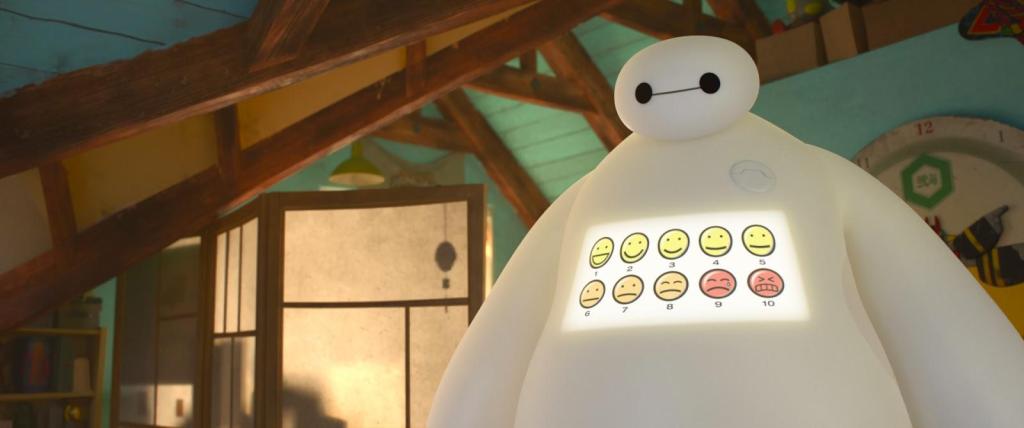
The Radical Simplicity of Responsiveness
What makes Baymax remarkable isn’t his advanced tech. Oddly enough, it’s something we say is uniquely human. It’s his empathy and seeing his compassion in action can teach us a lot about how inhuman care delivery often is.
Baymax does not just feel with his patient, he is responsive to him.
He listens.
He scans.
He adapts.
He stays.
He doesn’t impose a plan.
He doesn’t rush the interaction.
He doesn’t prioritize efficiency over experience.
He responds.
And in doing so, he reveals something uncomfortable about modern healthcare systems:
We’ve optimized for everything except responsiveness.
We measure throughput.
We track compliance.
We refine processes.
But too often, we fail at the most fundamental act of care, responding to the human being in front of us.
“I Cannot Deactivate Until You Are Satisfied With Your Care”
There’s a line Baymax repeats throughout the film:
“I cannot deactivate until you are satisfied with your care.”
It sounds almost naive, but imagine if we took it seriously. Not as a script, but as a design principle.
What would change if healthcare systems were built around that idea?
Care wouldn’t end when the visit is over.
It wouldn’t end when the chart is closed.
It wouldn’t end when the protocol is complete.
It would end when the patient says it does.
That is a fundamentally different model of care. One that shifts authority, ownership, and accountability.
One that centers not the system, but the patient’s experience of it. A truly patient centric system.
Baymax Doesn’t Lead the Interaction. The Patient Does.
There is something deceptively powerful about how Baymax operates.
He is not the center of the interaction.
The patient is.
Every action he takes is guided by:
- what the patient reports
- what the patient feels
- what the patient needs
He doesn’t override.
He doesn’t assume.
He doesn’t dictate.
He follows.
This is what I mean when I talk about patient-focused transformation. It is not about trying to guess which way the market is shifting, or accommodating to changing demographics. It is about building alongside patients, and following their lead in the process.
Because the future of healthcare will not be designed for patients. It will be shaped with them.
The Moment We’re In: AI and the Illusion of Advancement
We are entering a new era of healthcare defined by artificial intelligence.
Predictive models.
Generative systems.
Automation at scale.
The promise is extraordinary. But there’s a risk hiding beneath the surface. We may build systems that are more powerful than ever, and yet still fail to be responsive.
Intelligence is not the same as understanding, and automation is not the same as care.
Baymax works not because he is technologically advanced, but because his intelligence is anchored in responsiveness to the patient.
He doesn’t just process data.
He interprets it in context.
He adapts in real time.
He remains present.
Co-Evolution: The Future of Healthcare Systems
The most important idea Baymax models is that he evolves with the patient.
His care is not static.
It is not protocol-bound.
It is not one-size-fits-all.

It changes as the patient changes.
This is and must be the future of healthcare.
Not systems that scale.
Not systems that standardize.
But systems that co-evolve.
Systems that:
- learn from patient input
- adjust to patient needs
- refine themselves through interaction
- grow alongside the communities they serve
This is where technology has the potential to transform care.
Not by replacing human interaction, but by making responsiveness possible at scale.
The Inspiration We Shouldn’t Ignore
It’s easy to dismiss Baymax as fiction. As an idealized version of care that may never exist.
But I would argue something different.
Baymax is not unrealistic. He is aspirational.
He reflects a set of expectations that patients already have:
- to be heard
- to be understood
- to be cared for continuously, not episodically
- to be treated as individuals, not cases
In that sense, Baymax isn’t ahead of healthcare at all.
He’s aligned with patients right now and what they expect from their care encounters.
A Question Worth Asking
What if every healthcare interaction began and ended with a simple question:
Are you satisfied with your care?
Not as a survey.
Not as a metric.
But as a commitment to caring.
A commitment to listen.
A commitment to respond.
A commitment to stay.
Because in the end, the future of healthcare will not be defined by how advanced our technology becomes. It will be defined by whether we are willing to build systems that respond to the people they serve.

The Path Forward
The lesson of Baymax is not about robotics.
It’s about what happens when we build systems that:
- listen first
- adapt continuously
- and center the patient at every step
The organizations that succeed in the next era of healthcare will not be the ones that adopt the most advanced technologies. They will be the ones that use those technologies to become: more responsive, more adaptive, and more human.
They will be the ones that co-evolve with their patients. Just like Baymax does.
If we are serious about transforming healthcare, the question is not whether we can build more intelligent systems. It’s whether we are willing to build more responsive ones.
Because the future of care may already be asking us something simple, and we have yet to answer.
Are you satisfied with your care?





 Geoffrey Silvera, PhD MHA